1094 JOURNAL OF THE SENATE (2/19/2010)
SB 375, An act concerning abolition of the death penalty; amending K.S.A. 21-3452, 21-4622, 21-4634, 21-4635, 21-4641, 21-4706, 22-3405, 22-3705, 22-3728 and 22-4210 and K.S.A. 2009 Supp. 21-4619, 21-4642, 22-3717, 22-4902, 38-2255, 38-2271, 38-2312, 38- 2365, 39-970, 65-5117, 72-1397 and 75-52,148 and repealing the existing sections; also repealing K.S.A. 21-3439, 21-4623, 21-4624, 21-4625, 21-4626, 21-4627, 21-4629, 21-4630 and 21-4631.
On roll call, the vote was: Yeas 20, Nays 20, Present and Passing 0, Absent or Not Voting 0.
Yeas: Brungardt, Emler, Faust-Goudeau, Francisco, Haley, Hensley, Kelly, Kultala, Lee, McGinn, Morris, Owens, Pilcher-Cook, Reitz, Schmidt V, Steineger, Taddiken, Teichman, Umbarger, Vratil.
Nays: Abrams, Apple, Barnett, Brownlee, Bruce, Colyer, Donovan, Holland, Huelskamp, Huntington, Kelsey, Lynn, Marshall, Masterson, Ostmeyer, Petersen, Pyle, Schmidt D, Schodorf, Wagle.
A constitutional majority having failed to vote in favor of the bill, SB 375 did not pass.
EXPLANATION OF VOTE
MR. PRESIDENT: I vote no on SB 375 which would abolish the Kansas death penalty. Under threat of the Kansas death penalty, the killer of Kelsey Smith plead guilty and spared her family the agony of a trial or they may still be awaiting that trial. I believe human life is created by God and therefore of immeasurable value. Yes I can say I am prolife and vote to protect unborn life which is totally innocent and not had the opportunity to wrong anyone. Yet I also believe that it is just punishment to allow the death penalty in limited cases when someone has unjustly and violently taken another’s life.— KARIN BROWNLEE
Senator Lynn requests the record to show she concurs with the ‘‘Explanation of Vote’’ offered by Senator Brownlee.
MR. PRESIDENT: The people of my Senate district elected me to represent their views on the great issues of the day. It is an honor and a privilege to be elected to represent them. I have lived with, listened to, and discussed many issues with my constituents. This is one of the fundamental issues where I must represent their views. And while there are many issues pro and con, the people of my Senate district have made it clear that they support the death penalty for the most heinous of crimes.—JEFF COLYER
Senator Ostmeyer requests the record to show he concurs with the ‘‘Explanation of Vote’’ offered by Senator Colyer on SB 375.
MR. PRESIDENT: I vote ‘‘AYE’’ on SB 375. The record kept by my secretary shows that every one of my constituents who contacted me on this issue asked me to support the bill. The concerns they raised varied widely: the terrible possibility of executing an innocent person, prolonging the suffering of a victim’s family, the need to maintain respect for human dignity, the ineffectiveness of the death penalty as a deterrent or way to get a plea bargain, the estimated 70% greater cost of a case taken to execution vs. lifetime incarceration, and the requirement that the death penalty should reflect the ‘‘conscience of the community’’ which may not be possible if a significant percentage of potential jurors are not permitted to serve on a capital case because they oppose the death penalty. I appreciate the Senate Judiciary Committee working out the details and moving this bill forward, the Majority Leader scheduling the debate, and the committee chair carrying the bill. It made it possible for me to express the wishes of my constituents to live in a state that does not allow for the death penalty, no matter how limited. — MARCI FRANCISCO.
Senator Hensley requests the record to show he concurs with the ‘‘Explanation of Vote’’ offered by Senator Francisco on SB 375.
MR PRESIDENT: In time.....Over the course of Time will always come reflection and that reflection will bring Abiding Confirmation or Deep Regret. May God have mercy on the souls of these ‘‘justice’’ seeking Americans today. And always. In this Time and in this hallowed Place, with God’s abiding Grace . . . we almost made a real Difference. — DAVID HALEY
MR. PRESIDENT: The death penalty has been on and off Kansas statutes since the late 1800’s. Although placed back on the books in 1994, no one has been executed since 1965. The death penalty has not been applied equitably across the state. The issue of justice is mirrored in two ways, some seeing justice when a murderer is executed, others when he is locked up without any amenities and with time to think about the horrible crime he committed. Many family members of murder victims who are against the death penalty would prefer life without parole. Having a death penalty was low on the list of priorities of the National Poll of Police Chiefs for preventing crimes. Dollars spent would be better used to prevent future heinous crimes, preventing the wrong people from walking the streets. Dollars could be spent on law enforcement, corrections, parole, drug and alcohol programs, or invested in pre-and post-natal programs. This is a very emotional and controversial issue; people on both sides feel strongly. Although we may have like to avoid the discussion, as a legislature we have the responsibility to deal with issues and allow our constituents who want repeal of the death penalty the opportunity to make their case. — CAROLYN MCGINN.
Senators Faust-Goudeau, Kelly, Kultala, Morris, Owens, Umbarger and Vratil request the record to show they concur with the ‘‘Explanation of Vote’’ offered by on SB 375.
MR. PRESIDENT: I vote NO on SB 375. The people who elected me to represent them in the 40th Senate District expect me to vote their views. It is an honor to have been elected by them, and I take that privilege very seriously. Although this is a very deeply felt issue on my part, I hold my Catholic faith very dear, my constituents have always trusted my judgment. Without giving them an opportunity to respond with such short notice on this issue, I feel I can explain the no vote. The majority of my constituents prior to today’s debate, have made it clear they support the death penalty for the most heinous of crimes. — RALPH OSTMEYER
MR. PRESIDENT: I have thought many years about the efficacy and effectiveness of the death penalty. For many years I have believed that the death penalty has no deterrent effect what so ever. I also believe there is clear and compelling evidence that innocent men have been put to death. I have defended the death penalty as a tool for prosecutors to use to gain cooperation from those accused of crime. However, the advocacy for the repeal of the death penalty by Therese Bangert, John Vratil, Carolyn McGinn, David Haley, and others have convinced me to move on from those outdated positions. I enjoy freedom . . . to be outdoors, to travel, to be with my family and friends. For me, the more cruel punishment is life in prison, alive but without freedom. It is true that we Americans, by keeping the death penalty, remain in league with nations, such as Iran, Yemen, North Korea, and Saudi Arabia. I prefer to join the nations who have attained universal health care for their citizens, established comprehensive early childhood education, resisted the economic burden of the military-industrial complex, and ended the death sentence. — CHRIS STEINEGER
Friday, February 19, 2010


Tuesday, February 9, 2010

Tuesday, December 1, 2009
About the War & Peace Dialogue
November 30, 2009
by Ron and LouAnn Voth (rlvoths@msn.com)
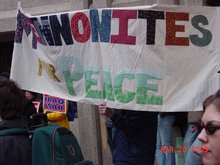
We would like to respond to several statements at the November 22nd Peace & Justice Dialogue (with the four officers from the Command & General Staff College) that we didn’t have time to address:
1. Major Robert spoke of putting down his gun and using his mind in his military service as if that was not using violence.
Does this mean someone like Osama bin Laden or Khalid Sheikh Mohammed shouldn’t be accountable for the processes they facilitated on 9-11-01? We’re sure neither of them have personally initiated force for many years. They just facilitated and enhanced it’s use with their minds.
2. Major Robert spoke of a “CO” (Conscientious Objector) Commanding Officer.
Isn’t it odd for a Commander to order people to perform tasks they personally consider immoral? We try to imagine organizing someone to rob people because we can’t morally participate in stealing ourselves. It’s even more morally abhorrent to force someone else do something you personally believe to be wrong. Staying in his military position is either milking it for the benefits or not being brave enough to take a stand.3. We’d like to revisit the tax resistance stand.
We’d like to hear a military view on the logic of prosecuting mosque’s in the United States for funneling money to Al Qaeda or the Taliban. We presume the mosques are considered accomplices in terrorist efforts for providing financial support. How does that extrapolate to our military support through personal income taxes? Are we also accomplices in attacking Iraq when we finance it with our current tax structure?
4. We’d like to revisit the problem of pacifists living under the protection of the military but not contributing to their protection:
There is a difference between working for the American kingdom and working for God’s kingdom.
Countries like Canada and Australia have at least as much freedom as we do and didn’t have to go to war to get them. It’s the art of negotiation.
It is important to recognize what the military protects…..and it is not necessarily the citizens or the Constitution- Will the military protect us from a government that tortures, kidnaps people on foreign soil and removes them to countries that torture? Would the military stand up against attacking countries without proof of wrong doing in hand, or be the invasion force? Will the military stand against a government that releases the names of CIA agents (if acceptable, that same government might do the same to it’s military personnel) or fires Federal Judges for political gain? Will the military oppose secret prisons or serve as guards? Will the military refuse to hold people arrested without charges or even protest a government that spies and wire taps it’s citizens? Based on recent history, we suggest the military’s allegiance doesn’t allow for them to protect us from abusive governments or Constitutional violators and are likely forced by their authorities to be the enablers.
It is not the military that will oppose abusive governments. It is the people that create change. It starts as a minority opinion, and with logic, persuasion, and media exposure civilians are the eventual force for change. In that sense, the military needs our protection to keep their government from sending them into harm’s way unnecessarily, from forcing them to abuse prisoners, or be accomplices in abductions and secret prisons.
We don’t fault the military for this powerlessness. They aren’t allowed to insert themselves into the political realm due to laws prohibiting it. But, we will ask the question of who is protecting whom? They actually need someone not obligated to serve the authorities to expose the authorities.5. Our society will produce what we celebrate.
When the Iraq War is over, what will we put on the memorial? What will we want our society to remember about the war?
Here are our some of our choices:
a. The bust of a pacifist from Hesston College that negotiated with Iraqi leaders during the successful war-ending “surge.”
b. A checkbook that funded the war and paid Sunnis not to fight during the successful war-ending surge.
c. The dying face of a mother representing one of the 60,000 innocent Iraqi civilians that paid the ultimate sacrifice.
d. Or, the recruiting tool — a statue of one of the 5,000 soldiers killed while riding in an armored humvee.6. We’d like to recognize the unique position “JAG” officers represent in being able to speak to these issues.
We are all products of the data we believe to be foundational to our life paradigms. This data was often imprinted by our upbringing which often has limited perspective and illustrates why the “apple doesn’t fall far from the tree.” It is exciting to see two diverse groups talking about an issue we disagree on and risk inputting new data into our paradigm. We should recognize the unique position JAG officers have on legal issues and commitment to authority. Since the Bible represents several covenants, (of which we ascribe to adhering to the “New Covenant”) it would be useful to understand from a military perspective the “legal” obligations God has inserted into the New Covenant and how such a covenant is binding to our daily lives? And, conversely, what is the implication for our disobedience of His authority.
Subscribe to:
Posts (Atom)